

Home |
Procedures |
General Dentistry | Veneers / Lumineers
What are Veneers?
Cosmetically, to create a uniform, white, beautiful smile.
Crooked teeth.
Misshapen teeth.
Severely discolored or stained teeth.
Teeth that are too small or large.
Unwanted or uneven spaces.
Worn or chipped teeth.
What Are the Advantages of Veneers?
In rare instances, veneers can chip or crack, in which case
they would have to be replaced. Since enamel is removed in the
procedure, the process is not reversible, and you may become
more sensitive to hot and cold foods for the same reason. If you
grind your teeth in your sleep, you may be asked to wear a
mouthguard when you go to bed. Many people who grind their teeth
in their sleep don't even know it, but your dentist will be able
to tell you if you are one of those people from the wear on your
teeth.
Since porcelain veneers are more resistant to stains and
chipping, they are generally more expensive. Lumineers are a
particularly popular type of porcelain veneers that do not
require your teeth to be shaved and can even be placed over
crown or bridgework. A custom-made set of Lumineers can be
installed in 2-3 visits and is proven to last over 20 years.
What does getting porcelain veneers involve?
The Den-Mat Corporation has patented a type of porcelain veneer
called Lumineer, and we are proud to announce our full
certification in Lumineer application. Lumineers are different
than regular veneers in that:
Lumineers work great for fixing gapped teeth, teeth that slope
inward, or teeth that are too small. Because there is no
drilling, Lumineers are nearly painless to apply.
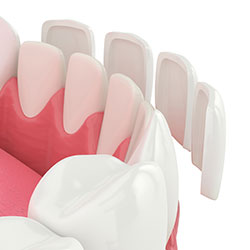
One of the most popular and
effective developments in cosmetic dentistry, veneers are thin,
custom made casings that cover the front side of your teeth.
Veneers are used to correct uneven teeth, worn enamel,
discoloration, chipped teeth and irregular spacing, and can last
over 20 years. In some cases, veneers can serve a restorative
purpose and can protect a damaged tooth from further harm.
Reasons for porcelain veneers:
Veneers can give your teeth a more natural, aesthetically
pleasing appearance and are stain resistant and soft on gums. In
some cases, veneers can serve a restorative purpose and can
protect a damaged tooth from further harm.
What Are the Risks of Veneers?
Types of Veneers
Getting veneers usually requires two visits to complete the
process, with little or no anesthesia required during the
procedure. The teeth are prepared by lightly buffing and shaping
the surface to allow for the thickness of the veneer. A mold or
impression of the teeth is taken and a shade (color) will then
be chosen by you and the dentist.
On the second visit the teeth will be cleansed with special
liquids to achieve a durable bond. Bonding cement is then placed
between the tooth and veneer and a special light beam is used to
harden and set the bond.
You will receive care instructions for veneers. Proper brushing,
flossing and regular dental visits will aid in the life of your
new veneers.
Depending on the experience of your dentist and the material or
brand being used, veneers can cost from $500 to $2000 a tooth.
Porcelain veneers are generally the most expensive and longest
lasting. Lumineers can cost from $700 to $1100 per tooth.
Will My Insurance Cover Veneers?
As this procedure is elective and primarily cosmetic, most
dental insurers will not cover veneers. However, veneers can be
financed either through your dentist or an outside company such
as Care Credit or DentalFeePlan,Lumineers
The information in the article is not intended to substitute for the counsel and expertise of a medical professional. We encourage you to discuss any decisions about treatment or care with your dentist.